
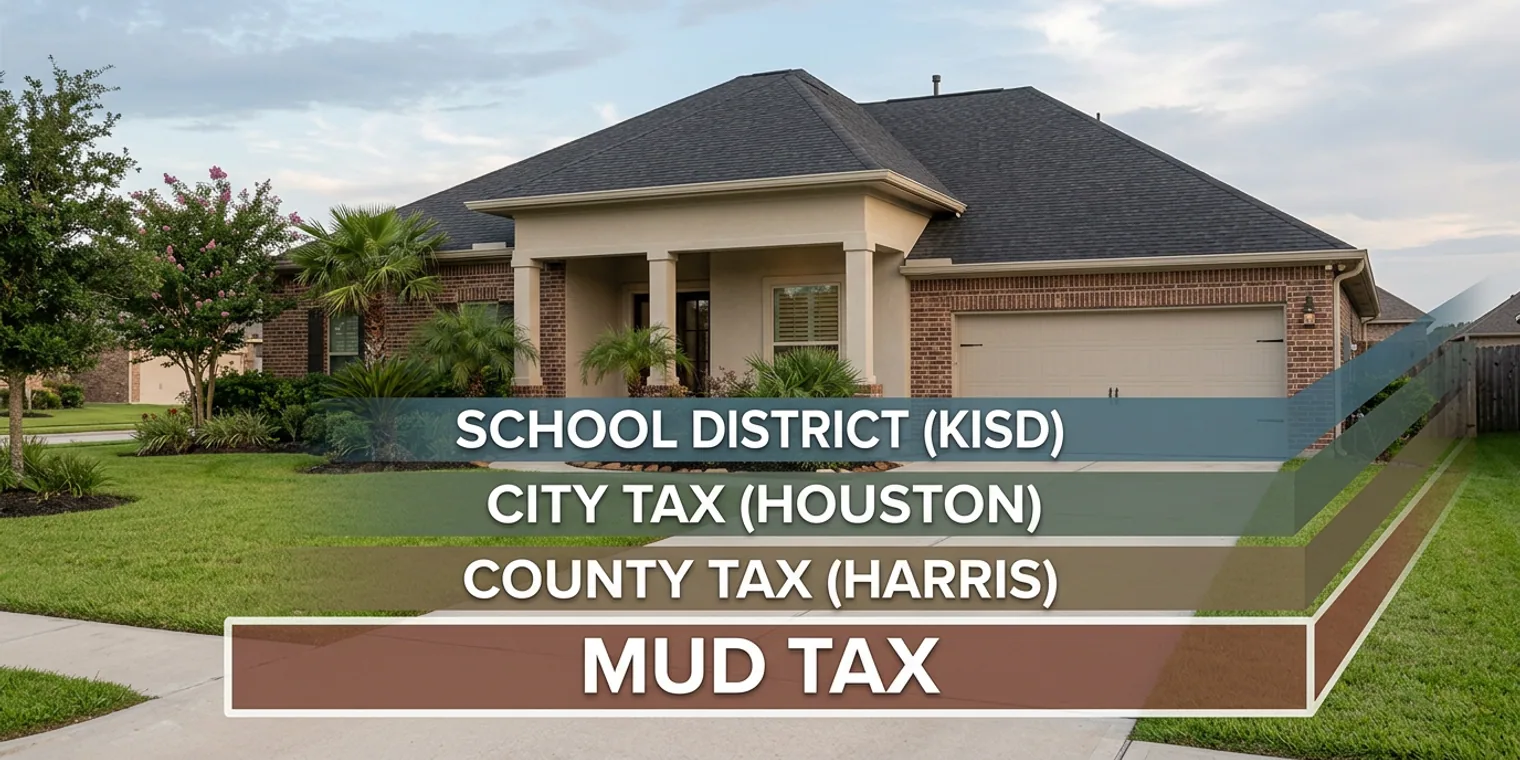
A municipal utility district is a local governmental entity with defined powers and boundaries. Research the exact district serving a property, its adopted rate, taxable value, debt and separate service charges. There is no single West Houston MUD rate or guaranteed schedule of reductions.
What is a MUD?
Municipal utility districts are one type of Texas water district. Their authority and services depend on their governing documents and applicable law. The Texas Commission on Environmental Quality’s water-district guide explains district types, oversight and how residents can locate their district.
Do not infer MUD status from whether a home looks new, has a city mailing address or lies near another subdivision. Use the actual property records and confirm the district name. A development can involve different districts or sections with different obligations.
Follow the property to the district
- Search the exact property in FBCAD, HCAD or Waller CAD, according to its county.
- List every taxing entity and copy the district’s complete legal name.
- Use TCEQ’s district resources and map to cross-check the district and find contact information.
- Obtain the district’s adopted rate, current financial documents and available debt information from its official records.
- Review the notice to purchaser, title documents and service information with the appropriate professionals.
Which costs should you separate?
| Item | What to verify |
|---|---|
| Property-tax levy | Tax year, adopted rate and applicable taxable value |
| Water and wastewater | Service provider, usage rates and fixed charges |
| Other fees | Connection, transfer or other applicable charges |
| Debt and infrastructure | Current obligations and documented plans |
| Exemptions | Whether the specific unit allows the benefit assumed |
A property-tax levy and a water bill are not the same expense. Include both where applicable, and avoid assuming an exemption used by the school district also applies to the MUD.
Do older MUDs always have lower taxes?
No. A district’s rate depends on its finances, debt, operating requirements and taxable base. Age alone cannot determine your cost, and paying down one obligation does not guarantee that taxes disappear. Compare current documents and several years of adopted rates, then ask the district about questions the records do not resolve.
For an illustrative calculation, $350,000 of taxable value at an invented $0.80 rate per $100 produces $2,800 annually. That is only the example district’s levy. It excludes other taxing units and service charges, and it is not a quoted rate for a real district.
Compare actual homes using the same assumptions
A Fulshear new home and a Cypress resale may have different tax and service arrangements. Neither the mailing city nor the existence of a MUD decides which home is affordable. Use the same tax year, financing assumptions and complete ownership-cost categories for both properties.
The main tax and MUD guide provides the wider comparison. The tax-bill explainer shows why taxable value needs to be read by taxing unit.
Official resources checked October 4, 2026. This guide replaces unsupported region-wide rate ranges with a method for finding the applicable district’s records.
Frequently asked questions
Are water charges included in MUD property tax?
Do not assume so. Verify the service provider’s charges separately from the district’s property-tax levy.
Will a MUD rate necessarily decline as it ages?
No. Review adopted rates, debt and operating obligations rather than predicting from district age.
Can I identify a MUD from the mailing city?
No. Confirm the exact property record and district boundaries.
Put the guide in local context
Use these community guides to narrow the search, then verify the exact property’s records.
Get guidance for your specific move.
Online research is a useful starting point. The home, neighborhood and timing still need to work together. Text John with what you are considering and get a practical next step.
Text John