
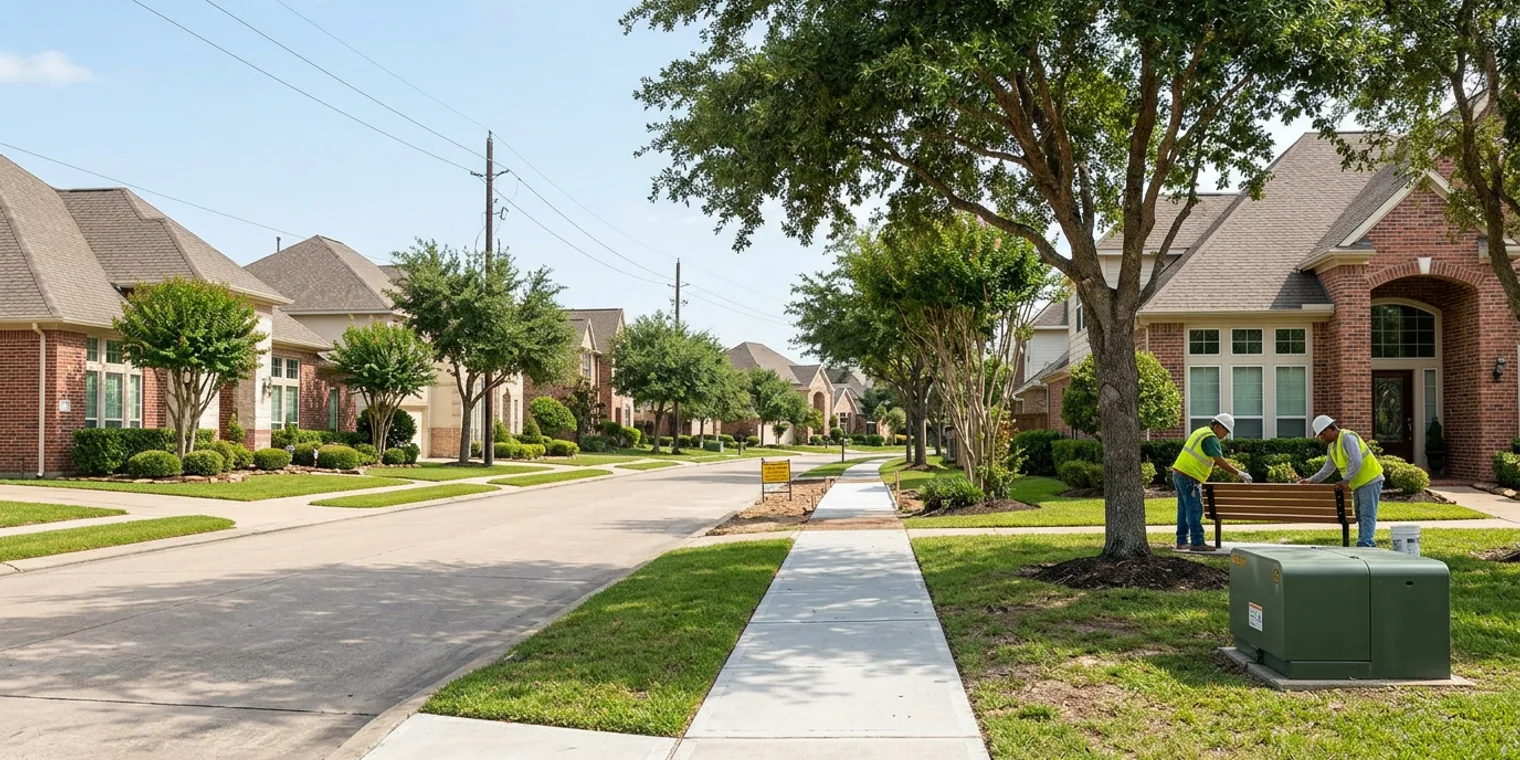
Before valuing a proposed amenity or infrastructure improvement, verify its location, approval, funding, delivery stage and ongoing cost. Compare a home using what exists today, then assess future plans separately.
Who is responsible for the improvement?
A developer’s concept plan, an HOA budget, a utility-district bond and a public-road project are different kinds of evidence. Start by identifying who owns the facility, who will pay to build it and who will maintain it after completion.
For a new-home search around Fulshear, ask for the current community plan and written information about included amenities. For an established Katy property, review HOA documents and existing facilities. Neither a sales rendering nor a city name proves that a particular home has access to an amenity.
What stage has the plan reached?
| Stage | Evidence to look for | What remains uncertain |
|---|---|---|
| Concept | Dated plan identifying its author | Approval, funding, scope and timing |
| Approved | Recorded decision and conditions | Procurement, construction and changes |
| Funded | Budget or financing documents | Delivery and operating costs |
| Under construction | Current project update | Final completion and opening |
| Operating | Actual access rules and maintenance arrangements | Future dues, repairs and service changes |
For state roads, consult TxDOT Project Tracker. For a utility district, the TCEQ water-district resources provide maps and guidance for locating district information. An HOA amenity requires the association’s own documents.
What costs belong in your comparison?
Ask whether the amenity is included in dues, subject to a separate fee or available only to certain sections. Read the current budget, reserve information when available and notices of approved assessments. Do not assume that a lower initial fee will remain unchanged after development is complete.
A useful illustrative comparison is two homes at the same asking price: one has an operating pool included in documented dues; the other advertises a future pool. Compare the present costs and facilities first. Treat the future pool as uncertain until its access, funding and delivery are documented. This is a decision example, not a description of a particular development.
How should drainage and construction be checked?
Public drainage work and a home’s lot drainage answer different questions. Read the Fort Bend County Drainage District’s guidance, review FEMA mapping and have property-specific concerns assessed. A nearby drainage project is not a guarantee against flooding.
Visit the lot and its access roads during normal activity. Review adjacent land plans, construction entrances and potential noise. Confirm questions in writing with the responsible party before making assumptions in an offer.
Keep a dated decision file
Save the source, date, map, responsible organization and unresolved questions for each material claim. Recheck these before signing or closing if circumstances change. Use the new-construction guide for contract and inspection planning, and the tax/MUD guide for the annual-cost calculation.
Resource links checked October 4, 2026. This article does not announce a new project or promise an opening date.
Frequently asked questions
Does a rendering guarantee an amenity will be built?
No. Check approvals, funding, delivery terms and the documents governing access.
Can an amenity add to ongoing costs?
Yes. Verify dues, separate fees, assessments and maintenance responsibilities in the actual documents.
Put the guide in local context
Use these community guides to narrow the search, then verify the exact property’s records.
Get guidance for your specific move.
Online research is a useful starting point. The home, neighborhood and timing still need to work together. Text John with what you are considering and get a practical next step.
Text John